-
Decolonial Trans Tech Framework (IN PROGRESS)
Advised by: Patrick Shih
Trans Technologies is an emerging field focused on how Trans Tech is designed, built, and used to support Trans individuals and communities. Oliver Haimson’s Trans Technologies conducts interviews with over 100 Trans Tech creators, showing that most Trans-oriented tools and platforms are developed by independent creators, community members, and activists operating with limited resources and little institutional support. These tools tend to be short-lived and only about 19% draw on Human-Computer Interaction (HCI) methods. Without grounding in established design frameworks and critical theories, Trans Tech projects risk reproducing unintended harms, such as reinforcing transnormative assumptions or excluding those at the intersections of further marginalization such as Trans people of color, disabled Trans people, and nonbinary individuals. These limitations point to a broader structural problem: the gap between accessing academic knowledge and the community-based labor of those who are actively building Trans Tech. Haimson places Trans Tech as the intersection of HCI and Trans Studies, but there is a need to consider how other fields of study can further contextualize Trans Tech experiences and inform both inclusive and equitable design approaches. Many Trans Tech creators design their tech outside of academia, where HCI knowledge is typically shared. As a result, the methods, theories, and best practices of HCI often remain inaccessible to the people who need them most. Additionally, HCI as a discipline has evolved beyond traditional design and usability frameworks. Recent work in Trans-inclusive, Feminist, and Queer HCI demonstrates that HCI increasingly draws from interdisciplinary fields to address issues of power, marginalization, and lived experience. Emerging work in decolonial HCI furthers this by challenging Western, institutional, and normative assumptions embedded in computing research and technological development. Researchers should recognize not only the interdisciplinary nature of Trans Tech but also the sociotechnical conditions Trans Tech creators face with no established framework. Therefore, to address this gap, I present a theoretical framework for Trans Tech that is at the intersection of HCI, Feminist, Queer, and Decolonial Theories that privileges diverse Trans experiences and community expertise in Trans Tech design. This framework especially centers Afro-Latin Decolonial Theories to create resources accessible to Trans Tech creators working outside traditional academic contexts.
Trans Sex EDucation Tool (IN PROGRESS)
Advised by: Patrick Shih
The new field of Trans Technologies has opened the door to understanding the ways that technology can support trans individuals. Existing Trans Technologies are focused on a multitude of areas – helping trans individuals through online communities, safety technologies, transition tracking, extended reality, reducing dysphoria when navigating the internet, appearance changing technology, etc. However, there is a lack of established trans technology that allows trans people to learn sex education in context to their trans body. In Oliver Haimson’s study of over 100 interviews of trans technology creators, there are few technologies that are specifically related to trans sex education. There are platforms like Plume and QueerDoc that are trans-affirming telehealth services but these are more related to accessing hormones or other medical care than sex education. Similarly another tool called TransZap is being developed to create a database of trans-competent healthcare providers but again, these providers can not teach trans individuals everything they need to know about sex education. Haimson notes the development of a trans-inclusive porn site named HoneyComb (previously called Royal Jelly) in his book Trans Technologies; however, it still hasn’t been released and may take a few more years. Such a tool could be helpful in counteracting stereotypical perceptions of trans individuals in sexual content online, but only with the addition of easily accessible education resources. In order to understand the design needs for a transgender sexual education tool, we conducted a survey (n=50) and interviewed 10 transmasculine individuals about their experiences finding sexual education in online contexts and their preferences for a future sexual education tool.

Queer People of Color Experiences on Lex (IN PROGRESS)
Advised by: Austin Toombs and Patrick Shih
Collaborators: Samuel Mayworm, Mel Monier, Oliver Haimson
Lex, a queer owned and operated platform, prides itself on being a queer-focused social networking app where users can post personal ads for friendship, dating, tasks, and other social connections in their local area. During Lex’s development, its founder Kel Rakowski faced scrutiny over lack of consideration for queer people of color (QPOC) and promised to implement QPOC specific features such as a QPOC-only filter, which was never implemented, and their absence points to the need for research the experience of Lex users who are TPOC (Trans People of Color) and a part of other marginalized communities, such as trans individuals in the Midwest where there are limited queer and trans resources. These concerns are furthered by the mobile app conglomerate 9count’s acquisition of Lex in September 2024, signaling a shift away from an independent, community-driven queer social network towards a broader system of Rainbow (Queer) or Trans Capitalism through venture-capital funding. We conducted semi-structured interviews with TPOC users in the Midwest (n=10) to understand how Lex’s changing governance, design priorities, and unfulfilled promises towards inclusivity shape users’ experiences on the platform alongside what these shifts suggest about the platform’s trajectory as a queer social media space.
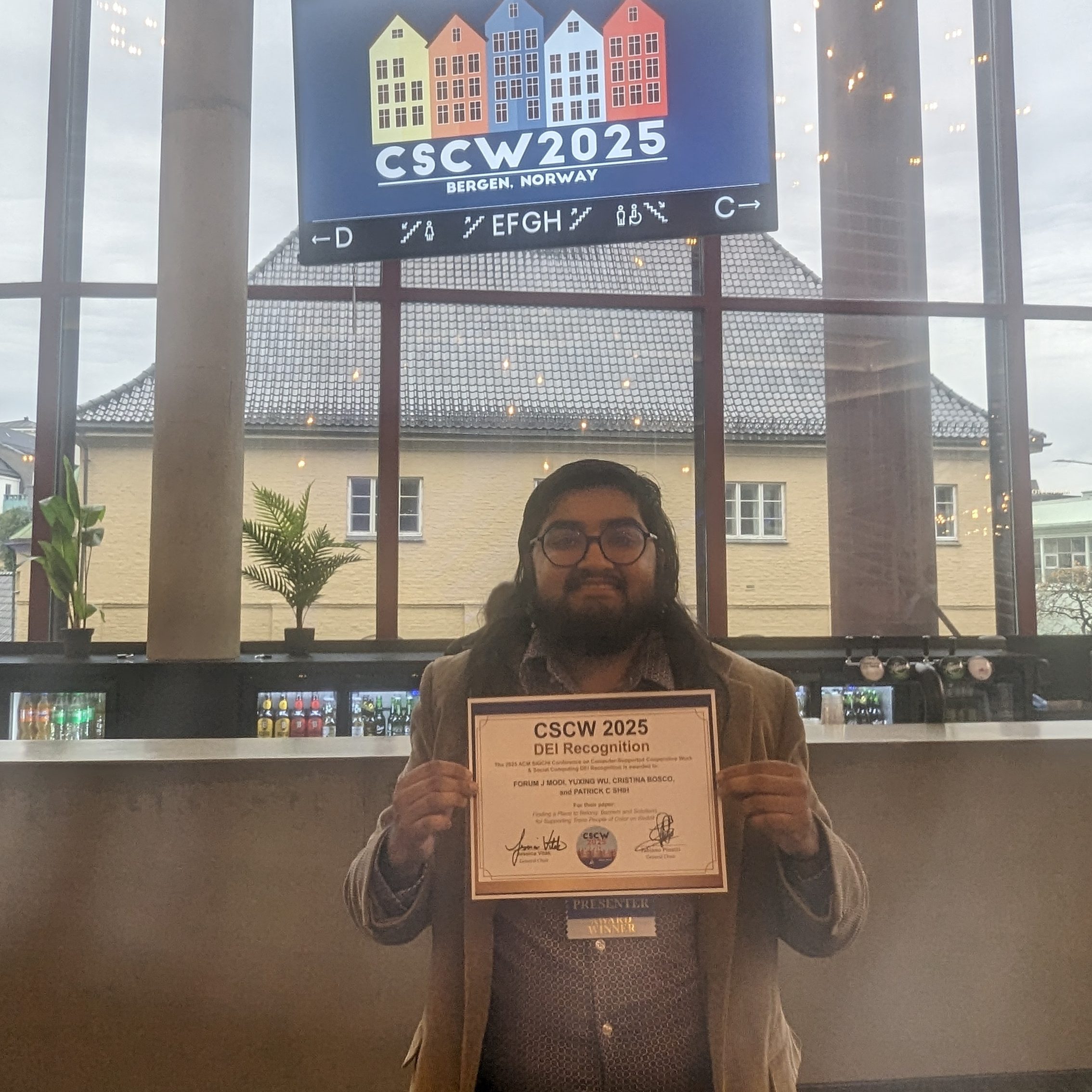
Finding a Place to Belong: Barriers and Solutions for Supporting Trans People of Color on Reddit (Published)
Advised by: Patrick Shih
Collaborators: Cristina Bosco, Yuxing Wu
Historically, transgender people of color (TPOC) have been silenced in white trans spaces for not fitting into transnormativity – the typical white, binary, skinny, and privileged image of trans people, and for raising concerns related to race, culture, and ethnicity. Social media and online communities serve as supportive spaces for transgender (shortened to trans) individuals; however, trans people of color require even more support combating systematic oppression, managing increased levels of discrimination, and navigating their cultural backgrounds. In order to understand how TPOC use social media, we explore the experiences of TPOC on Reddit. We used the Reddit API to obtain Reddit posts from four prominent transgender subreddits (r/ftm, r/mtf, r/trans, and r/Non-Binary) which included the phrase “people of color” or the abbreviation “POC”, resulting in a total of 145 posts and 2867 comments. Thematic analysis was then used to identify three themes of discussion – alienation, support, and existing in physical spaces, which informed our design considerations. Experiences shared in the Reddit posts indicated that TPOC feel overshadowed by white trans individuals in online communities and desire to build connections with other TPOC both online and in person. We propose design recommendations for both Reddit as a platform and subreddit moderators that regulate online trans communities to encourage growing networks among TPOC, improve communication among users and moderators, and design spaces that center POC voices within subreddits, all of which provide a much more supportive online environment for TPOC.

“I Don’t Need a Megaphone to Be Helpful”: Probing the Role of Technology in Pro-Choice Abortion Activism (PUBLISHED)
Advised by: Katie Siek
Collaborators: Colin LeFevre, Aswati Panicker, Sitha Vallabhaneni, Nikhil Dinesh
The legality of abortion in the United States of America is rapidly shifting, creating a nebulous, challenging context for pro-choice abortion activists. In this in-progress work, we align ourselves with pro-choice activism as “academic accomplices” and investigate the technological habits and needs of pro-choice activists in the conservative US state of Indiana. To date, we have conducted 14 design interviews with potential / current pro-choice activists in Bloomington, Indiana, and have designed a cultural probe to examine the role of technology in pro-choice activism. We aim to understand the challenges of pro-choice activism and opportunities for supportive technology.

Connecting Remote Families Through Sharing of Cooking Experiences (PUBLISHED)
Advised by: Christina Chung
Collaborators: Colin LeFevre, Aswati Panicker, Nikhil Dinesh
Families can facilitate beneficial discussions on healthy eating, and in so doing provide important support for each other’s health habits. However, distance, e.g., an adult child moving away, makes this interchange more challenging. In this paper, we introduce Cooking Stories, a research tool designed to investigate how the sharing of cooking experiences between remote families can be supported by HCI researchers. We conducted an IRB approved interview study with five participants between the ages of 20-67. Preliminary findings indicated that Cooking Stories addressed sharing barriers that study participants had experienced in previous systems. Based upon our participants’ engagement with the Cooking Stories prototype, we identified three themes: focusing on cooking experiences, incorporating cooking processes, and emphasizing familial community. We discuss the potential for these themes to be expounded upon by future work, in order to better support the sharing of full cooking experiences between distanced family members.

 forumjmodi.com